What if you could have the marketing expertise of a CMO without the full-time commitment or salary? It’s possible, and it’s unlocking growth opportunities with minimal overhead. For many businesses, especially those in the tech world, this approach is becoming the secret to scaling smarter.
With the rise of fractional Chief Marketing Officers, companies can tap into executive-level strategy and leadership without the heavy price tag of a full-time hire. But what does this really mean for your business? How does a fractional CMO compare to other models, like in-house or freelance marketing leaders, and which one is best suited for your current needs?
As you explore these options, you’ll want to understand the unique advantages of each. From flexibility and cost savings to expertise in navigating digital complexity, each model offers distinct benefits. Whether you’re a startup with limited resources or an established company looking for specialized guidance, choosing the right marketing leadership could be the catalyst for your next phase of growth.
What Is a Fractional CMO, In-House CMO, and Freelancer?
When it comes to marketing leadership, businesses often face the decision of whether to hire a full-time Chief Marketing Officer (CMO), work with a fractional CMO, or rely on a freelancer. Each model comes with its own set of benefits, limitations, and unique structures, and understanding these differences can help you make the best choice for your company. All the insights are based on our own experience leading marketing strategies across a variety of companies in B2B tech.
Fractional CMO
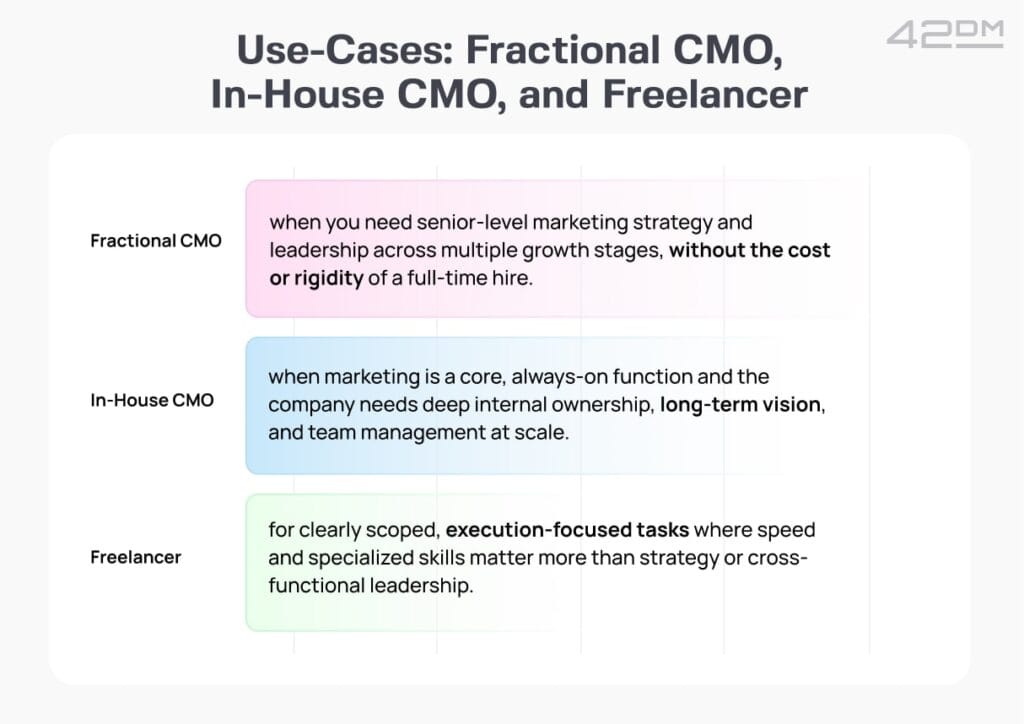
A fractional Chief Marketing Officer is a senior marketing executive who works part-time, offering strategic direction and leadership to businesses that need marketing expertise but don’t require or can’t afford a full-time CMO. Fractional CMOs typically engage on a project basis, helping businesses with specific goals like defining go-to-market strategies, scaling demand generation, or optimizing marketing operations.
Typical responsibilities include:
- Developing and executing marketing strategies
- Overseeing marketing teams and vendors
- Aligning marketing goals with business objectives
- Mentoring in-house marketing teams
- Analyzing data to optimize campaigns and improve ROI
Scope & commitment:
A fractional CMO typically works part-time or on a contract basis, giving businesses access to top-tier marketing leadership without the overhead of a full-time hire. While they are focused on high-level strategy and long-term growth, the engagement is usually more flexible in terms of time commitment.
In-House CMO
An in-house CMO is a full-time executive who is dedicated to overseeing the entire marketing function of a company. They are deeply embedded in the company’s day-to-day operations and provide consistent leadership and long-term strategy to drive growth. This role is essential for businesses that need a senior leader to guide the full spectrum of marketing activities, from high-level strategy to day-to-day execution.
Typical responsibilities include:
- Leading marketing teams and departments
- Overseeing campaign execution and daily marketing activities
- Building and maintaining brand identity
- Managing budgets and reporting to the executive team
- Collaborating with other departments like sales, product, and customer success
Scope & commitment:
An in-house CMO is a full-time, permanent role that requires deep investment in the company’s marketing and growth strategies. They work across all marketing functions and usually have a long-term commitment to the business’s success.
Freelancer
Freelancers, unlike fractional Chief Marketing Officers, are typically marketing professionals who offer specialized services on a project basis. They often work with companies needing specific skills like content creation, SEO, paid media, or graphic design. Freelancers are often more affordable than in-house CMOs or fractional CMOs but come with less integration into the company’s long-term strategy.
Typical responsibilities include:
- Managing specific marketing tasks or projects
- Providing expertise on demand without long-term commitment
- Delivering high-quality, specialized work within a defined timeline
Scope & commitment:
Freelancers are flexible and can be hired for short-term or project-based work. They often don’t provide the same level of leadership or strategic direction as a fractional or in-house CMO, but their flexibility and specialized skill sets make them ideal for companies with temporary needs or limited resources.
Why This Debate Matters: Marketing Leadership Models for Modern Businesses
These days, competition is fierce, and marketing leaders are expected to do more than just manage campaigns; they must consistently drive growth and align marketing strategies with business objectives. And as marketing becomes increasingly complex, particularly with the rise of AI, companies need clear, strategic guidance to keep up with their competitors.
For many businesses, especially those operating on tight budgets or with lean teams, it’s critical to find the right balance between hands-on leadership and execution. Whether it’s a fractional Chief Marketing Officer, an in-house executive, or a freelancer, each model offers its own benefits and challenges. The key is finding the right fit for your company’s needs, one that can adapt to rapid changes without overloading resources.
Understanding the strengths and limitations of each model is essential for companies that need to stay ahead without overextending themselves.
Pros & Cons of Each Model
While the decision between fractional, in-house, and freelance marketing leadership might seem straightforward, the differences can significantly impact your business’s growth. Let’s break down the pros and cons of each option and see how they align with your company’s goals and needs.
Fractional CMO: Flexibility and Expertise
A Fractional Chief Marketing Officer offers the best of both worlds—senior-level expertise without the financial commitment of a full-time hire. This model is perfect for businesses looking for high-level strategic leadership but who don’t need someone in the office every day. Fractional CMOs bring immediate value, leveraging their experience to shape go-to-market strategies, optimize funnels, and provide clear direction for the business.
However, the fractional approach does come with its limitations. While you get the flexibility to scale resources, you may find that the CMO’s availability is more limited compared to an in-house hire. This can be problematic during peak moments when quick decisions are required. Additionally, because the fractional role is part-time, the CMO might not be deeply involved in the day-to-day execution of marketing activities, which can leave some gaps in long-term strategy execution.
For example, a SaaS startup might find a Fractional CMO beneficial for defining its go-to-market strategy, positioning, and messaging without the overhead of a full-time commitment. However, during busy periods, the lack of immediate availability might become a challenge.
In-House CMO: Full Control, Full Commitment
An In-House CMO is the most traditional model, offering full-time dedication and control. This model is perfect for businesses that need someone to not only shape strategy but also be deeply embedded in the daily workings of the company. In-house CMOs are fully integrated into your team, working closely with both marketing and other departments to ensure that all strategies are aligned with overall business objectives. This continuous, hands-on involvement fosters consistency and allows the CMO to drive long-term growth effectively.
That said, this commitment comes with a big price tag. The cost of a full-time CMO can be a significant burden for many smaller businesses. Beyond just the salary, you’ll also have expenses related to recruitment, onboarding, and benefits. Additionally, an in-house CMO might struggle with flexibility. While they’re able to tackle challenges, they can sometimes become overwhelmed with the sheer breadth of responsibilities, and pivoting quickly can be challenging when the business faces sudden market shifts.
Take, for example, one of our clients, an e-commerce business that’s scaling rapidly and needs a CMO who can oversee the full spectrum of marketing, from strategy to execution. In this case, an in-house CMO would be ideal for managing internal teams and ensuring long-term strategic consistency.
Freelancer: Agile and Budget-Friendly
A freelancer can be a great option for businesses looking for specialized skills on a short-term basis or in areas where you don’t need ongoing, full-time support. Freelancers often bring deep expertise in particular areas, whether that’s content marketing, paid media, or customer acquisition. This flexibility makes them an attractive choice for companies with specific needs or projects. They can also start quickly and dive straight into execution without the lengthy hiring process that comes with bringing someone in-house.
However, freelancers come with their own set of challenges. The lack of long-term commitment means there can be a constant cycle of onboarding and offboarding, which can cause a disruption in marketing continuity. And since freelancers often work independently, your internal teams will need to do more coordination to ensure that the freelancer’s work aligns with broader company goals and strategies. It’s also worth noting that while a freelancer’s rates are often lower than an in-house hire, they’re typically not as comprehensive in their skills; they might excel in one area, but may lack the broader strategic oversight a full-time CMO would provide.
For instance, a startup needing immediate help with content creation for a short-term campaign could find a freelancer to be the perfect solution. They would get the expertise they need without the overhead of hiring a full-time employee, but once the project ends, the business may need to go back to square one to find someone else for the next phase.
Cost Comparison: What You Actually Spend
When evaluating different marketing leadership models, cost is a major consideration, especially for businesses operating with tight budgets or limited resources. But beyond just the salary, retainer, or hourly rates, there are a variety of hidden costs associated with each option. Understanding these costs is crucial for determining which model delivers the best value as you grow.
Salary vs Retainer vs Hourly
When comparing costs, the payment structure for each model plays a big role in your decision-making process. An in-house CMO typically requires a full-time salary, which can be expensive, especially when considering benefits and bonuses. However, this can be ideal for businesses needing consistent leadership and direction.
On the other hand, a fractional Chief Marketing Officer or freelancer typically works on a retainer or hourly basis, making them more flexible and affordable. This option allows you to scale marketing support up or down as needed, without the financial commitment of a full-time hire.
Hidden Costs
There are several hidden costs to consider beyond the obvious payment structure. Hiring an in-house CMO involves recruitment, onboarding, and training, which can take time and money. Additionally, you may need to invest in internal resources, tools, and software to support their work.
A fractional CMO or freelancer may reduce some of these costs, as they typically use existing tools and require less onboarding. However, if they require you to adopt their systems or work processes, this can add extra expenses.
Cost-Efficiency at Different Business Stages
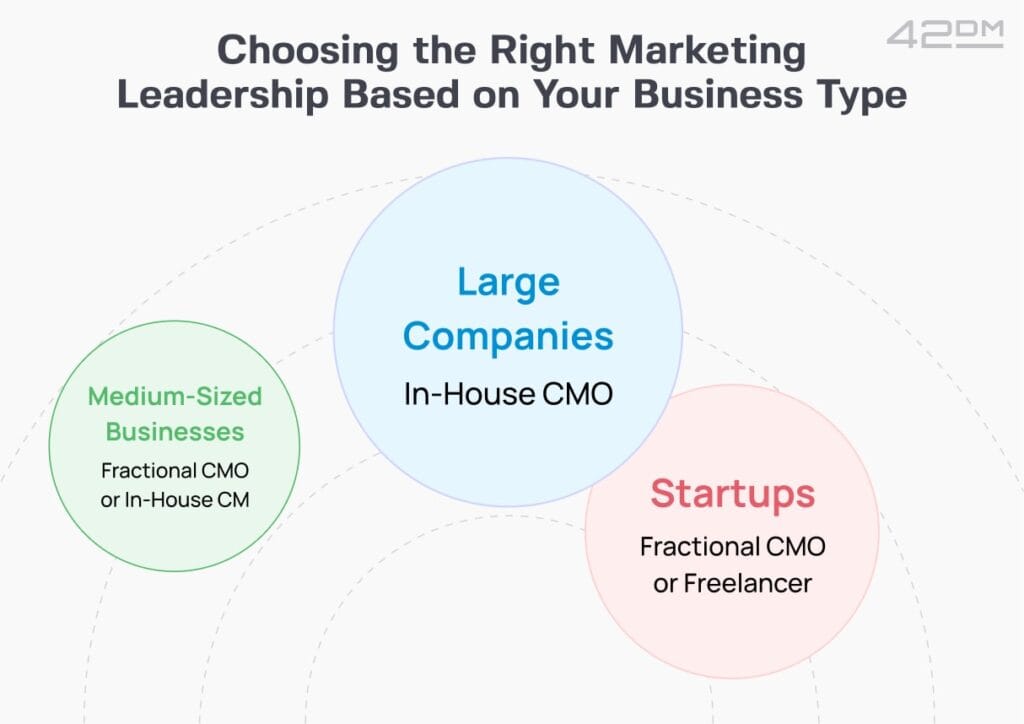
The most cost-efficient model depends on your company’s stage of growth. Early-stage businesses may benefit from fractional CMOs or freelancers, as they provide flexibility and expertise without the long-term commitment or salary burden of a full-time executive.
For more established businesses, an in-house CMO could be the better investment. Though the salary is higher, the long-term benefits of a full-time, dedicated leader may outweigh the flexibility offered by part-time models, especially for teams requiring consistency and deep company integration.
Fractional CMO Examples: What They Actually Do
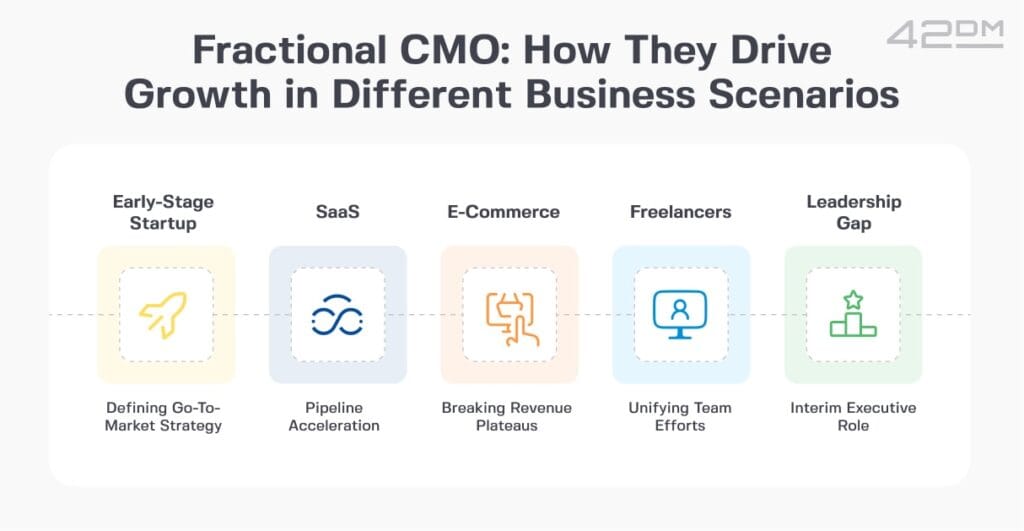
A fractional Chief Marketing Officer isn’t just a part-time strategist; they step into the business with clear ownership and deliver hands-on leadership where it matters most. Here are a few real-world scenarios that show what fractional CMOs actually do inside companies of different sizes and maturity levels:
Early-Stage Startup Defining Its Go-To-Market Strategy
A startup with a promising product but no direction would bring in a fractional CMO to build a foundation. They’re there to clarify the ICP, tighten market positioning, and translate the founders’ vision into a clear message the market understands. They outline the GTM strategy, set priorities, and build the first repeatable marketing processes — giving the startup a roadmap it can actually execute.
B2B SaaS Company Needing Pipeline Acceleration
A SaaS company has traffic, leads, and product interest — but the pipeline is struggling, conversions are low, and attribution is a mess. A fractional Chief Marketing Officer would step in to design a demand generation framework, rebuild the funnel, connect marketing activities to revenue, and introduce attribution models that give the business visibility into what’s working. Within a few months, the company will have clarity, better SQL quality, and a pipeline that moves.
E-Commerce Brand Plateauing in Revenue
An e-commerce brand hits a revenue ceiling and can’t seem to break past it. A fractional CMO steps in to audit acquisition channels, evaluate the creative strategy, and dig into lifecycle performance. They refine targeting, improve CRO, rebuild retention flows, and introduce structured testing. Instead of random acts of marketing, the brand finally has a coordinated strategy that lifts ROAS and increases customer LTV.
Company Relying on Multiple Freelancers with No Coordination
Let’s say a company is working with several freelancers — one for ads, one for content, one for email — but nothing feels consistent or connected. A fractional CMO brings alignment by unifying messaging, setting priorities, and creating SOPs the whole team can follow. The business instantly becomes more organized, efficient, and aligned.
Leadership Gap During a Transition
Sometimes a company simply needs leadership — fast. A fractional Chief Marketing Officer can step in as an interim executive during a hiring freeze, sudden resignation, or maternity leave. They maintain momentum, keep the team on track, support campaigns already in motion, and ensure no strategic initiatives stall. When the company is ready to hire full-time again, the fractional CMO helps design the role and supports a smooth handover.
Fractional CMO Agencies: What They Are & Why They’re Worth Considering
A fractional CMO agency gives you something a solo fractional CMO can’t: a senior marketing leader backed by an entire team. Instead of relying on one person, you gain access to broader capabilities — creative, content, analytics, SEO, performance marketing, martech, and AI tooling — all coordinated under one structure.
Because agencies have multiple vetted CMOs on their roster, they offer continuity and availability you won’t get from an individual. If your CMO is unavailable or bandwidth needs change, the agency can adjust quickly without disrupting your plans. Onboarding is also faster thanks to established playbooks, frameworks, and processes that don’t have to be built from scratch.
Another major advantage is quality and oversight. Your fractional Chief Marketing Officer has internal support, peer review, and accountability built into the engagement — something freelancers or solo CMOs typically can’t provide
Businesses often prefer agencies because they reduce risk, improve reliability, and offer a wider set of skills under one umbrella. Strategy and execution stay connected, pricing is more predictable, and it becomes easier to manage multiple marketing needs at once without hiring several different specialists.
When to Choose Which: Decision Matrix by Business Stage & Needs
Choosing between a fractional CMO, an in-house CMO, or a freelancer often comes down to your company’s stage of growth, budget, urgency, and the maturity of your internal team. Each model performs differently depending on what the business needs right now, not what it might need one day.
Here’s a quick way to look at how each option fits different situations:
| Business Need | Fractional CMO | In-House CMO | Freelancer |
| Budget Limits | Strong fit — flexible, lower cost | Weak fit — highest cost | Strong fit — affordable for tasks |
| Urgency / Need Fast Impact | Strong — fast onboarding | Weak — long hiring cycle | Medium — depends on role |
| Team Maturity | Ideal for early or mid-stage teams | Best for mature teams | Works when you already have strategic leadership |
| Strategic Leadership Needed | Excellent | Excellent | Weak — not ideal for strategy |
| Hands-On Execution Needed | Good when paired with support team | Good with full team built around them | Strong for execution-only needs |
| Scalability | Highly scalable — increase/decrease hours | Strong — built for long-term scale | Limited — depends on individual |
Finding the Right Fit For Your Business
- Fractional CMO: Best for businesses that need senior-level direction but aren’t ready (or willing) to pay for a full-time executive. They work especially well when the company is growing quickly, dealing with complicated marketing challenges, or needs clarity fast. Fractional CMOs offer flexibility and senior expertise without long-term overhead.
- In-House CMO: This is the ideal choice when the business has a stable budget, a mature marketing team, and a long-term need for someone who can own the entire marketing function. This model works best for larger organizations where the CMO can build teams, influence culture, and lead cross-functional initiatives.
- Freelancer: A practical solution when you need specialized execution rather than high-level strategy. Freelancers are great when you already have strategic leadership (internal or fractional Chief Marketing Officer) and simply need help producing content, running ads, or handling specific campaigns. They’re affordable and flexible, but they won’t replace a leader.
Common Mistakes to Avoid When Hiring Marketing Leadership
Hiring the right marketing leadership is essential for business growth, but it’s easy to make missteps that could lead to inefficiencies or missed opportunities. Here are some of the most common mistakes companies make when hiring marketing leadership, and how to avoid them:
Over-indexing on Cost Instead of Long-Term ROI
While it’s tempting to focus solely on minimizing costs, especially when budgets are tight, it’s important to remember that marketing leadership is an investment. Cutting corners on talent or opting for cheaper options without considering long-term ROI can lead to higher costs down the line. A strategic hire or partnership may come at a higher cost initially, but if they can drive growth and improve your marketing operations, the return on investment will more than pay off in the future.
Hiring a Full-Time CMO Too Early
Hiring a full-time CMO too early in the lifecycle of your business can be an expensive mistake. While it’s important to have strategic leadership, an early-stage company may not need a full-time CMO, especially if it’s still refining its product-market fit or working on the initial stages of marketing execution. Opting for a fractional Chief Marketing Officer or even a skilled marketing consultant can provide the leadership needed without the overhead of a full-time hire.
Expecting Freelancers to “Own” Strategy
Freelancers can bring significant value to specific marketing tasks, but expecting them to own the overarching strategy can be problematic. Freelancers are typically more focused on execution rather than long-term strategic planning. If your business needs a clear vision and roadmap for growth, relying on freelancers alone for this level of responsibility could lead to misalignment and missed opportunities. In this case, a fractional CMO or in-house executive is much better suited to define and execute a comprehensive strategy.
Hiring a Fractional CMO with No Operational Support
A fractional CMO can bring significant value, but without operational support, they can quickly become overwhelmed. It’s important that the fractional CMO is set up for success with a team, resources, and internal alignment to execute the vision. Without this support structure, even the best fractional Chief Marketing Officer might struggle to deliver good results. Make sure that operational elements, such as tools, teams, and processes, are in place before bringing in a fractional leader to ensure smooth execution.
Not Aligning Internal Teams Before Onboarding
Internal alignment is essential for marketing leadership to succeed. If your sales, product, and customer teams aren’t aligned with the marketing strategy, any new hire or agency will face challenges in executing their plans. Before bringing in any new marketing leadership, ensure that internal teams are aligned on goals, processes, and expectations. This alignment will ensure a smoother transition and greater success in executing your marketing vision.
How AI, Remote Work & Digital Trends Affect This Decision
With the latest advancements in technology, the role of marketing leadership is evolving. Factors like AI developments, remote work dynamics, and new digital trends are transforming the way businesses approach marketing and strategy. Here’s a look at how these changes affect the decision-making process when choosing the right marketing leadership model for your company.
AI’s Role in Speed, Experimentation, and Automation
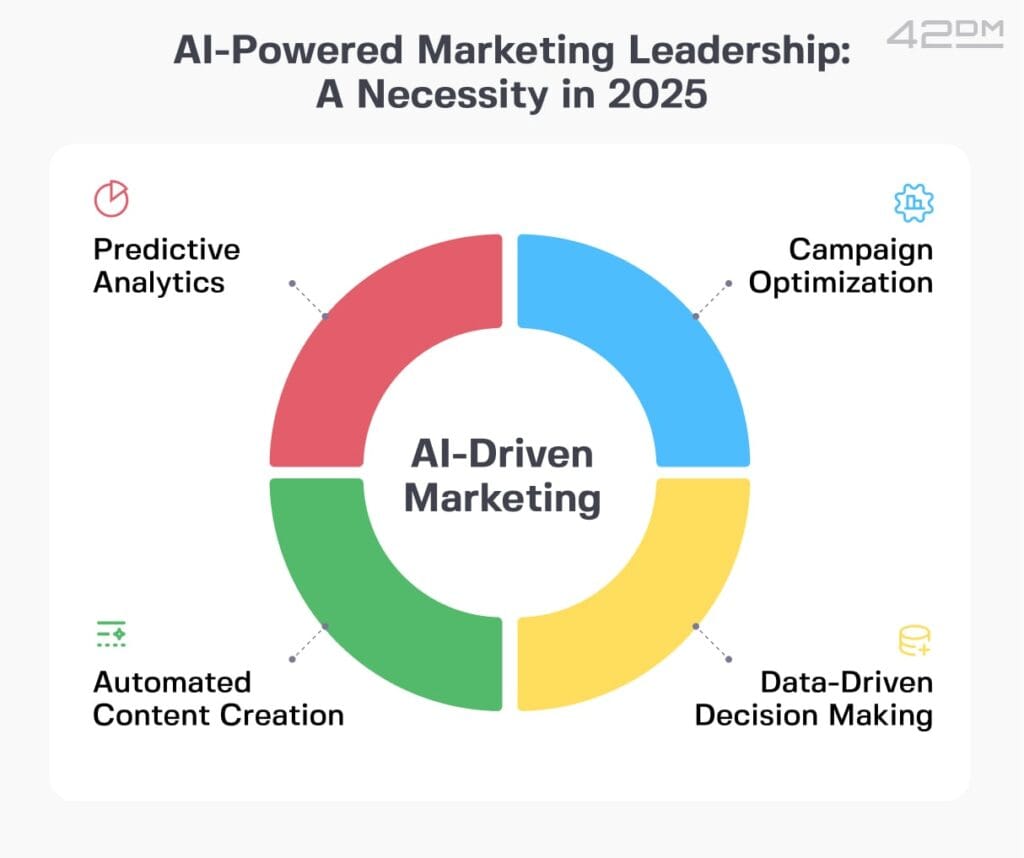
AI has revolutionized marketing by enabling businesses to speed up processes, experiment more effectively, and automate repetitive tasks. For marketing leadership, this means that modern CMOs need to be comfortable leveraging AI tools to make data-driven decisions quickly. With tools like predictive analytics, automated content generation, and campaign optimization, AI enables marketing leaders to make more informed decisions quickly, improving both efficiency and responsiveness. As a result, companies that embrace AI can iterate faster and scale more effectively, making it a key factor when choosing a marketing leader who can fully take advantage this technology.
Need for AI-Literate Marketing Leadership
AI has become a necessity in modern marketing. Companies need marketing leaders who can understand and apply AI technologies to improve everything from customer segmentation to content delivery and personalization. An AI-literate marketing leader can ensure that your business is making the most of the tools available, staying competitive, and adapting to rapidly changing market dynamics. Whether it’s leveraging AI for customer insights or using machine learning to predict customer behavior, having a leader who’s well-versed in these technologies can help accelerate growth and efficiency.
Why Modern CMOs Must Operate at the Intersection of AI, Content, and Analytics
The future of marketing leadership lies at the intersection of AI, content, and analytics. Today’s CMO must not only be able to craft compelling marketing strategies but also understand how to integrate data, AI-driven insights, and content creation into those strategies. This cross-disciplinary expertise ensures that businesses can execute highly personalized, data-backed campaigns at scale. CMOs who can operate across these domains will be able to drive faster, more effective marketing strategies that are adaptable and measurable.
Advantages of Fractional CMOs and Agencies in Early AI Adoption
Fractional Chief Marketing Officers and agencies offer a unique advantage when it comes to adopting new tools and strategies. Because they bring specialized expertise, they can help businesses implement AI and digital technologies faster and more effectively, without the long ramp-up time often required for full-time hires. This agility allows companies to leverage cutting-edge solutions quickly and efficiently. Furthermore, agencies offer flexibility, quickly scaling up their AI capabilities to meet the demands of the business, ensuring the integration of AI tools and methodologies across marketing efforts.
Real-World Scenarios: Which Model Works Best?
As we mentioned earlier, choosing the right marketing leadership model depends heavily on your company’s stage, budget, and specific needs. Let’s break it down by business stage to understand when each model works best and how each one aligns with different organizational needs.
Pre-seed Startup → Freelancer
At the pre-seed stage, startups are often lean and resource-constrained, so flexibility and cost-efficiency are crucial. A freelancer can provide the expertise needed to get off the ground without the commitment of a full-time hire. They’re perfect for defining initial messaging, setting up foundational marketing systems, and executing low-cost, high-impact strategies—helping the company establish a presence while keeping overhead minimal.
Seed/Series A → Fractional CMO / Fractional CMO Agency
As your business enters the Seed or Series A stages, marketing needs become more complex. At this point, a fractional CMO or fractional CMO agency is ideal. They bring seasoned leadership and strategic insight to help refine your marketing approach, optimize processes, and build scalable systems that align with your growth objectives.
Scaling Company → In-House CMO
For companies that have moved beyond the initial stages and are scaling, an in-house CMO becomes increasingly valuable. By this stage, the business has more consistent revenue and marketing operations, and an in-house CMO is crucial to drive long-term strategy, manage a growing team, and ensure the marketing function evolves alongside the business. They can offer a steady hand to steer the company’s marketing as it becomes a key driver of growth.
Enterprise or Complex Product → In-House CMO with Agency Support
When dealing with complex products or large-scale enterprise needs, the combination of an in-house CMO with agency support is often the best fit. The in-house CMO provides day-to-day leadership, overseeing integrated marketing strategies, while agencies bring in specialized expertise—whether it’s creative services, digital marketing, or advanced performance marketing—providing flexibility and depth to meet a range of different challenges.
Checklist: What to Evaluate Before Hiring
Before you bring on a fractional Chief Marketing Officer, in-house executive, or freelancer, it’s important to evaluate your business’s current needs, resources, and long-term goals. Here’s a checklist to guide your decision-making process and ensure you hire the right model for your situation:
Budget & Timeline
Start by assessing your budget and how quickly you need marketing leadership in place. Fractional CMOs or freelancers may offer a more budget-friendly solution if your resources are limited. However, if you’re looking for a more long-term commitment with higher costs, an in-house CMO might be better suited. Your timeline will also play a role. If you need marketing leadership to jump in fast, a fractional CMO or freelancer could be the ideal fit, while an in-house hire might require more time for recruitment and onboarding.
Internal Team Maturity
Consider the maturity of your internal marketing team. If your team is still in the early stages or requires more guidance, a fractional Chief Marketing Officer can help with mentorship and strategic direction while scaling the team’s capabilities. On the other hand, if you already have a solid team in place and need someone to lead and refine existing efforts, an in-house CMO might be the right call.
Leadership Needs vs Execution Needs
Evaluate whether your primary need is strategic leadership or tactical execution. If your business needs someone to lead overall marketing strategy, align teams, and drive long-term goals, a CMO (fractional or in-house) might be necessary. However, if your marketing department requires more execution-focused support, like content creation, campaigns, or lead management, a freelancer could provide a more targeted solution.
Complexity of Product/Market
The complexity of your product or market should play a big role in influencing your decision. If you’re offering a highly technical product or entering a new market with a steep learning curve, you may need a seasoned in-house or fractional CMO who can navigate those challenges with experience. For simpler products or less competitive markets, a freelancer with the right expertise might be enough.
Required KPIs and Expectations
It’s crucial to define what success looks like for your business. Are you focused on increasing lead volume, improving conversion rates, or driving revenue growth? The right marketing leader will help set these KPIs and track progress. Fractional CMOs and freelancers often work well for specific, short-term projects or campaigns, while in-house CMOs may be needed for more ongoing, enterprise-wide initiatives with longer-term KPIs.
Desired Level of Involvement/Availability
Lastly, think about the level of involvement and availability your business needs. An in-house CMO offers full-time availability, making them ideal for companies that need constant strategic oversight. If you’re looking for flexible support with the option to scale resources up or down, a fractional CMO or freelancer might be the best fit.
Choosing the right marketing leadership model is an incredibly decision that directly impacts your company’s ability to scale efficiently and achieve sustainable growth. So, whether you opt for a fractional CMO, an in-house hire, or a freelancer, the key is aligning your choice with your business’s growth stage, budget, and specific marketing needs.
Ultimately, the right marketing leadership model is one that grows with you. So, as you evaluate your options, consider your company’s current needs and where you’re headed. Need help figuring out your best fit? Reach out to us to explore how a fractional Chief Marketing Officer or other model can work for your business.
Your Questions, Answered