TL;DR: Most B2B AI companies run the wrong GTM strategy for their stage. 42DM’s benchmark of 100 AI companies shows that early-stage companies need trust and proof first — founder voice, customer evidence, media validation. Paid, SEO, and outbound scale only after that foundation is in place. Kate Vasylenko shared this framework at NY Tech Week 2026 in two sessions on GTM readiness and B2B AI growth.
Updated June 5, 2026.
At NY Tech Week 2026, B2B founders and GTM leaders kept circling the same question: as AI speeds up execution, floods channels with more content, and makes buyers harder to win over, what does a trustworthy go-to-market strategy look like now?
Kate Vasylenko, CEO and co-founder of 42DM, spoke at “Building LLM Powered Products in Production” on June 2, then co-hosted “How to Scale Business with People & AI” on June 3 with Ioanna Onasi from Dextego and Tijana Buric from Career Alchemist. Across both sessions, the conversation kept returning to a practical tension for AI companies: many can build quickly, but far fewer are ready to earn buyer trust at scale.

Why Most B2B AI Companies Run the Wrong GTM Playbook
On June 2, Kate joined a morning session for AI founders, technical leaders, and investors focused on what happens after an LLM product clears the prototype stage. The broader event covered product architecture, RAG, fine-tuning, and evals. Kate’s part focused on the go-to-market side.
Her core point: many AI products become technically ready before they become commercially ready and that gap is expensive. Teams can build a working product, launch campaigns, and still struggle to convert because buyers do not yet have enough proof to trust the company.
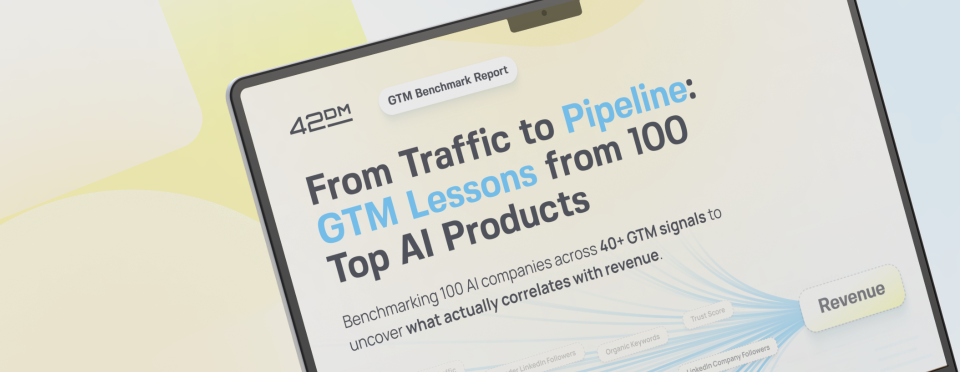
Kate shared findings from 42DM’s benchmark of 100 B2B AI companies and 100+ public GTM signals—a practical review of which signals moved with revenue at different stages of company maturity.
For early-stage AI companies, the signals that moved closest with revenue were founder voice, customer proof, media validation, owned LinkedIn audience, and paid or community channel quality. Classic scale signals like SEO authority, referring domains, brand search volume, structured webinar programs became more predictive only as companies matured and built public authority.
The implication is about sequence, not tactics. Early AI companies often spend like companies with mature authority: scaling paid, chasing SEO, testing AI search visibility, copying the public playbook of a larger competitor. Those tactics can work, but only when buyers already have enough evidence to believe the company is credible, when the trust layer is strong enough for that tactic to convert. If it isn’t, more visibility creates more leakage—buyers see the company, understand the offer, and still feel unsafe moving forward.
We see this regularly in 42DM client work. When a company increases paid spend before the proof layer is visible, response rates drop, CAC rises, and leadership starts questioning the channel. Leadership often blames the channel, when the real issue is that buyers do not yet have enough proof to move forward.
The takeaway: don’t copy the mature winner’s B2B go-to-market strategy too early. Build the GTM system that fits your stage today.
What the “Scale Business with People & AI” Workshop Covered
On June 3, 42DM co-hosted a working session at Fabrik in Tribeca for founders, GTM leaders, sales teams, and operators. The session covered three connected areas: GTM readiness and buyer trust, AI sales coaching and buyer conversations, and human skills and execution quality.
Kate led the GTM readiness portion using 42DM’s benchmark as the frame. The central question was direct: where does buyer trust break before pipeline forms?
Participants worked through two areas. First, the trust foundation—media and analyst validation, customer proof, founder and executive voice. Second, buyer evaluation—category clarity, path to buy, and product substance.
The core idea held across both: visibility creates attention. Trust decides whether that attention becomes pipeline.
AI can help strong GTM systems move faster with better research, faster content operations, improved sales prep. But AI cannot fix unclear positioning, a weak ICP, thin proof, or a team that isn’t ready to execute. That was the honest center of the workshop, and frankly the same conversation we have with most B2B tech companies before any channel work begins.
[Suggested image: 42DM, Dextego, and Career Alchemist hosting the People and AI workshop at Fabrik in Tribeca] [Suggested alt text: 42DM, Dextego, and Career Alchemist hosting an NY Tech Week 2026 workshop at Fabrik in Tribeca]
The B2B GTM Sequence That Actually Works: Relevance → Trust → Visibility → Pipeline
One theme ran through both NY Tech Week sessions: sequencing matters more than channel selection.
B2B tech companies move fast across tactics like AEO, Reddit, Product Hunt, AI outbound, founder content, events, paid search, community. None of these are wrong by default. The problem is activating them before the business is ready for that channel to convert.
From 42DM’s research and client work, the right GTM strategy for B2B follows four steps in order:
1. Relevance: Define who the product is truly for and which pain signals actually matter to them.
2. Trust: Build the proof layer that gives buyers a reason to believe: customer evidence, founder voice, media validation, named use cases.
3. Visibility: Scale through paid, events, partnerships, communities, or outbound once trust is strong enough to convert attention.
4. Pipeline: Turn that attention into sales conversations with buyers who are already pre-educated and pre-qualified.
This came up again at Generative AI Summit New York during the same week. Across conversations with GTM leaders in AI, cybersecurity, automation, and open-source companies, the same pattern appeared: AI adoption is becoming table stakes. Differentiation now comes from trust, distribution, and buyer confidence—not product features alone.
What to Validate Before Scaling Your B2B GTM
Before a B2B AI company scales paid, outbound, events, or automation, leadership needs to validate the foundation. A practical GTM readiness check covers:
- Is the ICP specific enough that sales and marketing agree on who to target?
- Is the category clear to a buyer who doesn’t live inside the product every day?
- Is there a strong founder or executive point of view that buyers can find publicly?
- Is there visible customer proof—named use cases, outcomes, or credible examples?
- Is the path to buy clear enough that an interested buyer knows what to do next?
- Are sales and marketing aligned on what quality pipeline actually looks like?
- Is AI improving the sales motion, or just generating more activity?
These questions matter because AI has lowered the cost of producing content, automating outreach, and testing campaigns. That speed helps, but it also means buyers now process more vendor claims, more automated messages, and more AI-generated content than they can reasonably evaluate. The companies that win attention still have to prove they’re worth trusting.
This is where demand generation has to evolve to do more than create activity. It needs to create the conditions for buyers to move from interest to a serious sales conversation. Content is central to that shift—supporting search, AI-generated answers, sales enablement, and buyer education simultaneously. Companies treating content as infrastructure rather than a campaign asset are better positioned as discovery behavior keeps changing.
Why Buyer Trust Is the Real Variable in B2B AI GTM
B2B AI buyers are more skeptical than most marketing teams expect. They’re not just asking what the product does. They’re asking: is this real? Who else trusts this company? Can I bring this to a buying committee? Does the team understand my risk?
Trust isn’t a soft brand layer. It’s the evidence layer that turns attention into pipeline.
Across 42DM client work and event conversations with GTM leaders, this shift shows up consistently: lower response rates to automated outreach, higher scrutiny of AI-generated content, stronger reliance on peer recommendations, and growing weight on founder and executive visibility. Trusted industry events are gaining value, not losing it.
For B2B AI companies, the trust evidence that moves buyers includes strong founder voice, clear category positioning, real customer proof, named use cases, media validation, analyst mentions, and a clear path to buy. Companies like Predibase, Meibel, and Freshworks have each worked through versions of this challenge at different growth stages — the specifics differ, but the trust-first sequence holds across all of them.
42DM’s Work With B2B Tech Companies
42DM has worked with US-based and global technology companies since 2016, across SaaS, AI, fintech, cybersecurity, enterprise tech, and B2B services. Client work spans B2B SaaS marketing strategy, B2B SaaS marketing strategy, account-based marketing, GTM strategy, demand generation, executive voice, HubSpot automation, content, paid media, and AI search visibility.
NY Tech Week was a chance to bring that work into live conversations with founders, GTM leaders, and operators building the next stage of B2B AI growth.
The main lesson from the week: AI can make B2B go-to-market faster, but speed only helps when the foundation is strong: relevance, trust, clear positioning, and a system that turns attention into pipeline.
u003ch2u003eFAQu003c/h2u003e