TL;DR
AI is now baked into almost every B2B marketing stack, but results are wildly uneven. The teams winning in 2026 are building GTM systems where AI, data, and humans each have a clear role.
In this post you’ll see:
- where AI reliably helps today (personalization, scoring, CRO, analytics),
- where it still fails (strategy, nuance, relationships),
- a checklist for evaluating AI platforms so you don’t just add noise to your stack.
Introduction
B2B marketing in 2026 is all about smarter automation, better targeting, and faster decision-making. And AI is at the heart of it all.
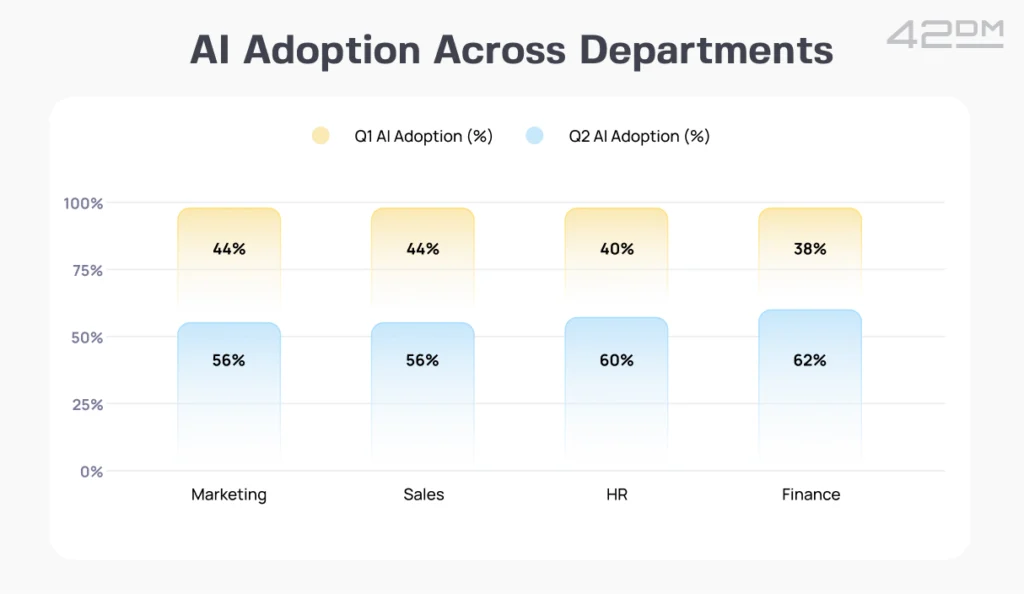
But AI’s role in marketing goes beyond just efficiency. It’s changing how we engage, analyze, and act on data. From personalizing content to optimizing customer journeys, AI is providing marketers with the tools they need to make more precise decisions, faster. 95% of B2B marketers already use AI‑powered tools in some capacity, yet most still sit at the “experimentation” stage, using AI mainly for copy and asset generation.
In this article, we’ll walk you through the AI tools we’ve tested at 42DM and how they’ve shaped our marketing approach, and how you can apply these lessons to integrate AI into your marketing workflows for better efficiency and precision.
AI’s Role in B2B Marketing: What Works and What Doesn’t
The 2026 reality: almost every B2B team has AI in the stack, but outcomes are wildly uneven. The pattern 42DM sees across various tech companies is consistent:
- AI is excellent at pattern recognition, summarization, and orchestration.
- It is fragile at strategy, originality, and nuanced judgment.
Knowing which side of that line a task sits on is now a core marketing skill.
As we’ve explored AI tools at 42DM and integrated them into our workflows, we’ve seen firsthand where AI really helps and where it falls short. While AI offers enormous potential for B2B marketers, it’s not a catch-all solution, and knowing when and where using it is critical for success.
Where AI Helps
AI transforms B2B marketing by streamlining processes, enhancing personalization, and improving decision-making speed. As such, more than a quarter (28%) of B2B marketers say they’re already experimenting with AI agents rather than just single‑purpose tools. What’s more, one of its biggest advantages is its ability to handle massive amounts of data, quickly analyzing trends, behaviors, and patterns that would take human teams much longer to uncover. This ability is especially useful when it comes to:
- Signal-Rich Personalization: AI models segment and score accounts and users based on behavior across email, product usage, website, and CRM, then trigger tailored content across channels. Instead of hand‑built segments, AI surfaces micro‑audiences (e.g., “dormant champions who re‑engaged via pricing pages”) and selects the right motion for each.
- Lead Scoring and Qualification: With AI, we can evaluate leads based on their behavior, interactions, and even external factors. AI models like the predictive scoring system we implemented have helped our clients focus their efforts on leads with the highest likelihood of converting. This has significantly improved both lead quality and sales conversion rates.
- Programmatic Advertising: AI allows us to optimize bids, placements, and targeting in real time. Through tools like dynamic bidding, we’ve increased ROI for paid campaigns, ensuring that budget is spent on the most promising opportunities.
- Predictive Analytics: AI’s ability to forecast trends and identify patterns before they become obvious to human teams is another area where it makes a real impact. For example, AI can predict shifts in customer behavior, helping us adjust strategies proactively rather than reactively.
Where AI Doesn’t
Despite its strengths, AI isn’t always the answer. There are scenarios where relying too heavily on AI can hinder rather than help. For example, in situations where creative thinking and nuanced judgment are required, AI doesn’t always deliver. Here’s where AI falls short:
- Category and narrative decisions: AI can remix what already exists. It cannot decide what your category should be, how you should position against a competitor, or which bets to make when data is ambiguous. Those calls depend on context, politics, and risk tolerance.
- High‑stakes messaging and complex buying committees: AI can draft copy, but it does not sit in board meetings or enterprise evaluations. It routinely misses tone, hierarchy of concerns, and internal language. Human marketers still need to adapt messaging to power dynamics, politics, and culture within accounts.
- Nuanced sentiment and relationship health: Sentiment models can flag “frustrated” or “positive,” but they cannot see the full story behind a champion’s short email or a CMO’s silence. In B2B, where deals can die on one internal objection, human account owners still need to interpret signals beyond the text.
How AI Changes Workflows
AI has had a profound impact on B2B marketing workflows, making processes faster, more efficient, and data-driven. For example, we’ve used AI-powered automation in multiple stages of the marketing funnel, from lead nurturing to automated responses.
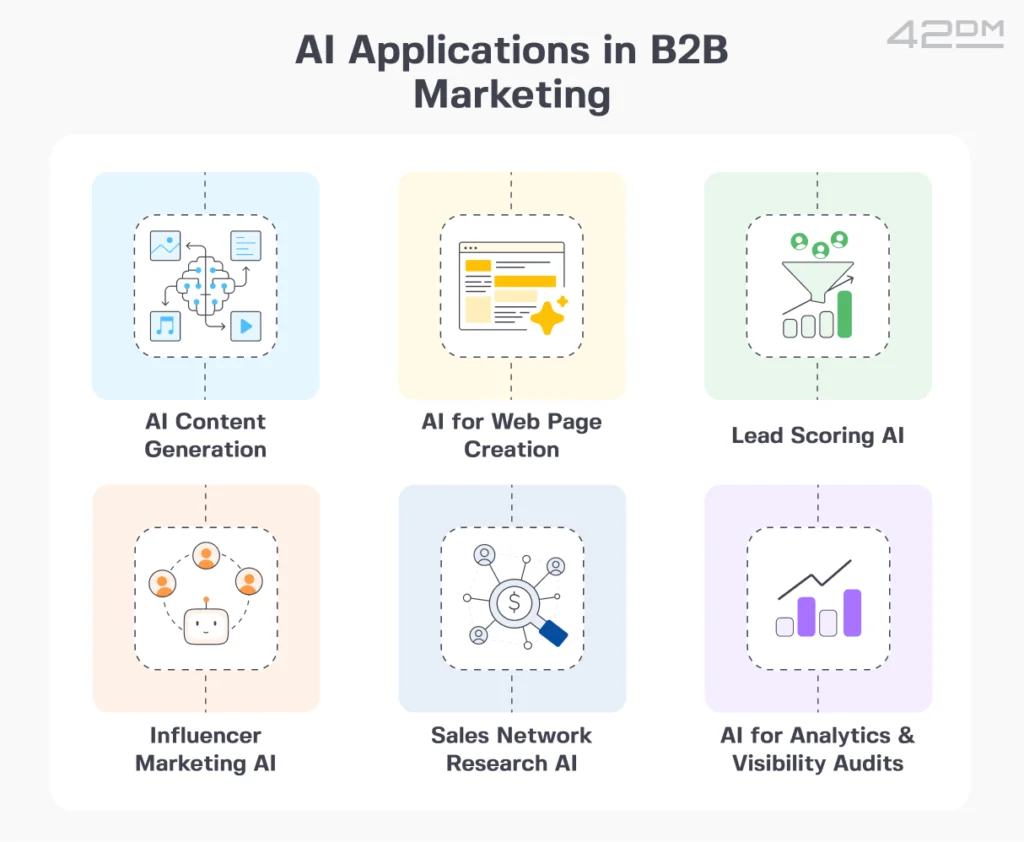
This helps free up time for our team to focus on strategy and creative tasks, while AI handles the repetitive, more time-consuming tasks.
- Automation of Repetitive Tasks: From content distribution to follow-up emails, AI has automated most of the tedious administrative work, allowing our team to focus on higher-value activities. For example, AI-driven email campaigns have helped us engage leads at scale without sacrificing personalization.
- Data Integration and Reporting: AI has simplified how we pull and integrate data from multiple sources, providing real-time insights that inform strategy. The tools we’ve integrated allow for automatic data collection, reporting, and analysis, giving us more time to act on the insights rather than gathering the data itself.
Where AI Creates False Confidence
While AI offers impressive capabilities, it can sometimes give marketers a false sense of certainty. Just because something is automated or driven by AI doesn’t guarantee success. In fact, relying too heavily on AI can sometimes lead to missteps. Here’s where we’ve seen that play out:
- Model worship instead of model monitoring
Teams treat the model’s output as ground truth instead of a hypothesis. If the training data over‑represents one segment or channel, the model will keep sending you there, and you might not notice until pipeline has already skewed. - “Automation first” instead of “design first”
Many teams automate broken journeys. AI just sends more of the wrong messages, faster. 42DM typically redesigns the system and decision rules first, then uses AI to orchestrate, not the other way around. - Over‑personalization without consent or value
Hyper‑targeted experiences can cross the line into creepy or noisy. B2B buyers increasingly expect clear value exchange and the option to dial down tracking, which purely algorithmic setups often ignore.
AI at 42DM: The Tools, the Process, and the Results
At 42DM, we’ve integrated AI into everything we do, from strategy to execution, making our marketing processes more efficient and effective for clients.
Content & Link Building
The Problem
Link building is a time-consuming process that requires meticulous outreach and content creation. For our B2C SaaS client, traditional link building was taking too long and yielding slow results. As we faced fierce competition in a saturated niche, we needed to scale quickly without sacrificing quality.
The Old Way
We were manually identifying relevant link-building opportunities and creating content from scratch. It was tedious, with limited automation and a long turnaround time.
The AI-Assisted Way
We started using an AI agent for link-building, specifically for generating content at scale, automating the research for high-quality link opportunities, and generating outreach emails. It has helped us automate the process, cutting time spent on link building by 60%, which boosted our ROI significantly.
What Changed
The efficiency of AI has completely transformed our link-building workflow. We’ve been able to scale faster, reach more opportunities, and deliver results at a fraction of the time it used to take.
Programmatic Page Creation
The Problem
Our clients often face the challenge of needing to cover large content gaps on their websites, particularly when competitors have hundreds more pages than they do. To remain competitive, they needed to quickly create high-quality, SEO-optimized pages in order to drive traffic.
The Old Way
Creating these pages manually was time-consuming and expensive. Our team spent weeks building out SEO content, which delayed our ability to cover content gaps.
The AI-Assisted Way
We experimented with programmatic AI to automate the creation of these pages. By leveraging AI tools, we quickly built optimized content tailored to specific keywords and user intent. The AI-assisted programmatic pages automatically generated meta tags, structured data, and SEO-friendly content in bulk.
What Changed
This method helped our clients rapidly cover significant content gaps, allowing them to compete more effectively with competitors who had much larger website footprints. We saw faster rankings and improved traffic, all while significantly cutting down on the time and resources needed to create those pages.
Lead Scoring
The Problem
Traditional lead scoring often leads to wasted resources. Many “high-scoring” leads turn out to be poor prospects, and valuable leads are missed because their behavior doesn’t match outdated scoring models.
The Old Way
Lead scoring was mostly based on actions like email opens, webinar attendance, or ebook downloads, which didn’t correlate well with actual buying intent. Our old system wasn’t predictive enough, and our sales team often ended up chasing the wrong leads.
The AI-Assisted Way
We’ve since integrated AI-based lead scoring, where we built a predictive model that better maps buying intent. The AI system uses multiple data points—intent signals, engagement depth, and fit—to prioritize leads more accurately.
What Changed
By incorporating AI into the lead scoring process, we were able to increase the sales acceptance rate by 156%, shorten the sales cycle by 41%, and increase the lead-to-customer rate by 73%. This predictive model has empowered our sales team to focus on leads that are truly likely to convert, optimizing their time and boosting our pipeline.
Influencer Discovery
The Problem
Finding the right influencers in B2B marketing can be difficult. We needed to identify influencers who aligned with our clients’ brand values and had genuine reach within niche communities.
The Old Way
In the past, we used traditional methods like manual research, checking follower counts, and engaging with potential influencers one by one. This process was incredibly slow and didn’t always yield reliable results.
The AI-Assisted Way
With our customer advocacy client, we applied AI to automate influencer discovery. The AI platform identifies influencers based on engagement metrics, audience quality, and shared values. It helps filter out influencers who don’t align with the brand’s mission or target audience.
What Changed
We now find the right influencers quickly, with more relevant matches for our clients. AI saves us hours of research while ensuring that we connect with the most effective brand advocates, increasing campaign effectiveness and audience engagement.
Sales Network Research
The Problem
In B2B sales, understanding the right network to target can be difficult. Identifying decision-makers, influencers, and connections within a specific company or industry required manual, fragmented efforts.
The Old Way
We relied on LinkedIn and other manual research methods to uncover potential leads and connections, which was time-consuming and often inaccurate.
The AI-Assisted Way
With one client, AI helped streamline this process by identifying connections within target companies. It scans multiple sources and surfaces relevant decision-makers and influencers within the company’s ecosystem, creating a comprehensive network map.
What Changed
Using an AI tool dramatically reduced the time spent on sales research, and our outreach efforts became far more targeted. By focusing on the right people within the organization, we improved the efficiency of our sales team and saw higher-quality conversions.
Analytics Agents
The Problem
Tracking and analyzing Google Search Console (GSC) data manually used to be slow and inefficient, and our clients’ websites often lacked insights into how their SEO efforts were impacting organic performance.
The Old Way
We would pull raw data from GSC and manually analyze it, which took considerable time and wasn’t always helpful. Identifying opportunities to optimize CTR was tedious and inefficient.
The AI-Assisted Way
We developed our own AI agent that processes GSC data automatically and provides actionable insights. The AI agent evaluates CTR trends, keyword performance, and user behavior to generate optimization recommendations that can be directly applied to improve organic performance.
What Changed
Using this AI agent cut down our data analysis time by 80%, allowing us to focus on strategic decisions instead of spending hours gathering insights. Our clients saw noticeable improvements in organic CTR and overall SEO performance as a result of AI-driven analysis.
HubSpot Breeze AI
The Problem
Managing marketing workflows efficiently while optimizing lead nurture can be complex, especially with increasing amounts of data and the need for timely actions.
The Old Way
Before implementing HubSpot Breeze AI, we used to manually set up workflows, segmentation, and email campaigns, which was time-consuming and prone to human error.
The AI-Assisted Way
With HubSpot Breeze AI, we’ve automated lead nurturing and segmentation to provide more personalized, timely communication. The tool helps identify where leads are in their journey and automatically triggers the right follow-up actions.
What Changed
The integration of HubSpot Breeze AI has allowed us to improve campaign efficiency and personalization at scale, leading to better engagement rates and smoother customer journeys for our clients.
AI in Practice: What We Learned from Testing and Experimenting
At 42DM, AI has become part of how we build GTM systems. But the biggest lesson from our experiments is that AI creates value only when it is placed inside the right layer of work.
Today, we think about AI through three layers:
- Intelligence layer — AI helps us read signals faster: search behavior, competitor moves, content gaps, pipeline patterns, attribution clues, and emerging shifts across accounts.
- Architecture layer — human strategists turn those signals into decisions: what to test, what to change, how to redesign journeys, what playbook fits this stage, and which bets are worth taking.
- Systemization layer — once something works, AI and automation help operationalize it through workflows, dashboards, playbooks, and repeatable execution.
What Scales
AI scales best when it supports the intelligence layer or the systemization layer.
One of the clearest examples came from experiments around website friction and CRO. We built agents that could detect drop-off points, surface likely friction areas, and recommend possible fixes. That worked well because the system focused on a narrow, recurring problem with lots of signal and clear next steps.
This is where AI becomes powerful:
- spotting anomalies across large datasets,
- prioritizing repetitive optimization opportunities,
- enriching records and routing actions,
- generating draft outputs that humans refine,
- turning proven actions into repeatable workflows.
In other words, AI scales when it helps us see faster or run faster—not when it tries to think for the team.
What Breaks
AI tends to break when teams ask it to replace the architecture layer. During our internal experiments, we saw that AI was strong at processing large volumes of data, surfacing patterns, and summarizing competitive inputs. But when the task shifted from “analyze” to “decide what this means in context,” quality dropped fast.
For example, one of our agents could turn messy competitive data into structured takeaways. That was useful at the intelligence layer. But it still could not decide which insight mattered most for a specific client’s GTM motion, buyer stage, or market constraints. That is architecture work, and architecture still needs human judgment.
The broader lesson: AI is dangerous when it gives teams false confidence that pattern recognition equals strategy. It doesn’t. Insight without context is still incomplete.
Where Humans Are Still Essential
Humans are still essential in the architecture layer, where the work is less about outputs and more about judgment.
In B2B marketing, this includes:
- deciding which market signal matters,
- choosing which audience or segment to prioritize,
- shaping positioning and narrative,
- judging tradeoffs between channels, timing, and budget,
- knowing when not to automate.
AI can help generate options, but it still cannot replace the strategic interpretation behind them. It does not understand internal politics, category nuance, founder ambition, or the trust implications of a GTM move the way an experienced strategist does.
That is why our approach is not “AI replaces marketers.” It is:
AI strengthens the intelligence layer, supports the systemization layer, and gives human experts more leverage in the architecture layer.
How to Evaluate AI Platforms for B2B Marketing
When evaluating AI platforms for your B2B marketing needs, the key is to look beyond the features and tools offered. The right AI platform should not only fit seamlessly into your existing workflows but should also provide long-term value that scales with your business. Here are the key factors to keep an eye out for:
1. Scalability
The platform should be able to grow with your business. As your data and requirements expand, so should the AI’s capabilities. Make sure the platform you choose can handle increasing volumes of data, support more users, and integrate with a larger range of tools as your operations evolve.
2. Integration Capabilities
Any AI solution should work well with the other tools you use, such as your CRM, email marketing software, and analytics tools. A platform with strong integration capabilities ensures that your AI-driven workflows are automated across the right systems, avoiding silos and maximizing efficiency.
3. Ease of Use
A complex AI tool might be powerful, but if it’s not user-friendly, it will only slow down your team. Choose platforms that offer a simple interface, easy setup, and good documentation. Your team should be able to use it without requiring extensive training or technical expertise.
4. Data Security and Privacy
In B2B marketing, dealing with customer data comes with a lot of responsibility. Ensure the AI platform you choose complies with GDPR and other relevant data protection regulations. Look for platforms that encrypt data, allow you to control access, and provide transparent privacy policies.
5. ROI and Cost-effectiveness
AI can be a significant investment. Evaluate the platform’s ROI potential, including how much time it will save, how it will improve your processes, and how much value it will add to your marketing efforts. Compare costs with the expected returns to ensure you’re getting good value.
To sum up, AI has the potential to revolutionize B2B marketing, but success lies in knowing where and how to apply it. Whether it’s automating repetitive tasks, refining lead scoring, or personalizing content, AI can bring efficiency and precision to your strategy.
If you’re struggling to integrate AI into your marketing efforts or need guidance on optimizing your AI tools, it might be time to bring in a partner. At 42DM, we’ve helped numerous clients apply AI in meaningful ways to drive results. Our experience in integrating AI-driven tools into GTM strategies means we understand both the challenges and the opportunities. We can guide you through the entire process, helping you avoid common pitfalls and achieve real, measurable improvements.
If you’re ready to take the next step in optimizing your marketing with AI, let’s talk. Contact us today to explore how AI could streamline your marketing and drive results.
FAQ