TL;DR:
• In April 2026, HubSpot rebranded its flagship INBOUND conference to UNBOUND after 15 years to reflect how growth now spans sales, service, operations, and AI rather than just inbound marketing.
• The event remains the same community and lineage, but it now covers the entire Go-To-Market (GTM) ecosystem and connected RevOps systems.
• Buyer research is moving into AI tools like ChatGPT and Perplexity, making Answer Engine Optimization (AEO) and overall AI visibility critical.
• Success requires a balanced system combining owned content, paid reach, and third-party earned validation rather than relying on organic traffic alone.
• Because AI makes generic content cheap and fast, proprietary data, customer proof, and human strategic judgment are more valuable than ever.
• B2B marketers should focus on fixing buyer friction and trust gaps across both their website and third-party sources instead of just optimizing for single-channel tactics.
HubSpot UNBOUND is the annual event formerly known as INBOUND. In 2026, HubSpot changed the name after 15 years to reflect a broader reality: growth no longer sits inside one marketing methodology. It now spans marketing, sales, service, operations, customer data, AI, and the full buyer journey.
For B2B marketers, that makes UNBOUND useful as more than a product conference. It is a good place to see how HubSpot and the wider GTM ecosystem are thinking about AI discovery, automation, distribution, trust, customer experience, and the changing role of marketing teams.
Below you’ll find 42DM’s annual conference coverage, our first-hand takeaways, and supporting research for B2B marketing leaders.
What is HubSpot UNBOUND?
UNBOUND is HubSpot’s flagship annual event for marketing, sales, service, operations, and growth leaders.
HubSpot announced the move from INBOUND to UNBOUND in April 2026. Its explanation was that the original event was built around inbound marketing, while modern growth now works across functions and increasingly depends on AI and connected systems. The event itself is a continuation of INBOUND, not a separate conference. The audience, community, and practitioner focus remain, but the scope is broader. Read HubSpot’s explanation of the INBOUND-to-UNBOUND change
Why does UNBOUND matter for B2B marketers?
The conference is useful because it sits at the intersection of several changes B2B teams are already dealing with:
- AI is influencing how buyers discover and compare vendors.
- Organic traffic is becoming a less complete measure of marketing performance.
- Paid, owned, earned, social, and expert-led distribution increasingly work together.
- Customer and product context is becoming more important as agents enter GTM workflows.
- Generic content is easier to produce, making original evidence and expert judgment more valuable.
- Marketing technology is moving closer to revenue operations and the full customer journey.
Those shifts are visible across 42DM’s own work as well. In our AEO research and client programs, we increasingly treat AI visibility as a system that spans content, technical foundations, authority, distribution, conversion, and measurement rather than as a standalone SEO tactic.
What We’ve Learned From Years of Attending
I’ve been to every INBOUND/UNBOUND since 2023. A few things stick with me, year after year.
The attendance mix alone tells the story. Early INBOUNDs were mostly marketing ops and content strategists. Now you’ve got equal numbers of sales leaders, customer success people, and revenue ops teams in every session. That shift reflects the fact that the marketing funnel no longer exists as a separate entity. You can’t solve a go-to-market problem from the marketing layer anymore.
The conversations have changed, too. In 2024, we heard genuine debate about best practices—is inbound dead, is ABM overhyped, do you need both? By 2025, that was gone. The new conversation was simple: “How do we actually operate when AI decides who gets found?” Not which model wins. The framework stopped mattering. Everyone was starting from the same blank slate.
What surprised me most was that authenticity mattered—as the only thing that cuts through when everyone has a chatbot, not as a brand strategy or content pillar. The winning teams were the ones willing to say “here’s what actually happened with our business” instead of “here are best practices.”
Those things aren’t on HubSpot’s agenda. You notice them when you’re sitting in a room with 20,000 people, all realizing at the same time that the old model is broken and nobody knows what replaces it yet.
What Replaces Inbound Marketing?
So what does the rename actually mean for your marketing strategy?
- Inbound marketing as a standalone strategy is effectively over. Publishing content still works. Inbound demand for B2B tech on Google is spreading and declining—it’s now scattered across platforms, harder and costlier to capture. You need to do more than SEO. Your buyers ask questions in AI assistants and ChatGPT, not just Google. They form opinions in communities and peer networks, not just blogs. And you need something that stands out when visibility is scattered and fractured.
- Authority lives in specificity and stories, specificity and stories, not general expertise. The old inbound play was “build a resource center and let SEO do the work.” That still has a place. But the teams winning UNBOUND conversations are the ones who can say “we built this for [specific problem] and here’s what happened”—not “here are best practices for [broad category].”
- The gap between marketing and sales has closed. Inbound worked when there was a clear handoff between lead generation and sales. That handoff no longer exists. AI tools, buyer communities, and transparent pricing information mean prospects are further along—or sometimes arriving differently. Revenue operates as a shared responsibility now, is direct collaboration.
If this resonates with where your team is already trying to go, UNBOUND is worth 72 hours in Boston. If you’re still focused on perfecting the funnel you have, it’ll feel like a distraction.
Year-by-Year Insights From Our Team
INBOUND 2024: what B2B marketers needed to know
The 2024 event was heavily shaped by generative AI, HubSpot Breeze, content quality, and the growing pressure to combine automation with more human and differentiated marketing. Read the INBOUND 2024 recap
INBOUND 2025: B2B marketing in the AI era
By 2025, the conversation had moved from AI experimentation toward how AI was changing discovery, customer journeys, content, and the operating model behind B2B marketing. Read the INBOUND 2025 recap
UNBOUND 2026: the first year under the new name
UNBOUND 2026 pushed the discussion further into AI discovery, Answer Engine Optimization, paid and earned distribution, brand trust, agentic workflows, and the quality of decisions behind increasingly automated execution.
What changed from INBOUND to UNBOUND?
The biggest change is scope. INBOUND was closely associated with a specific marketing methodology. UNBOUND keeps the same event lineage but reflects a wider GTM environment where marketing, sales, service, operations, and AI increasingly work as one connected system. That broader framing is visible in the topics now taking center stage: AI agents, customer context, answer engines, paid distribution, CRM-connected workflows, brand trust, and cross-functional GTM execution.
For B2B marketers, the practical implication is that the event is less about one channel or methodology and more about how the entire growth system works together.
What themes keep showing up across the conference?
AI is becoming part of buyer research
A growing share of research now happens inside tools such as ChatGPT, Gemini, Perplexity, and AI-powered search experiences. Buyers can compare categories, vendors, pricing, implementation options, and trade-offs before they reach a company website.
That changes the questions marketing teams need to ask. It is no longer enough to know whether a page ranks. Teams also need to know whether AI systems can find the company, understand it accurately, and find enough external evidence to trust the claims being made.
Our recent webinar with Gumshoe breaks that work into six dimensions: foundation, content, authority and trust, distribution, conversion, and measurement. Watch: How Top B2B Brands Get Cited by AI
Distribution is becoming a system
Owned content defines what the company says about itself. Earned coverage and third-party evidence help validate those claims. Paid distribution creates attention where organic reach is no longer guaranteed.
For B2B companies, those layers increasingly reinforce one another. Strong content without distribution can disappear. Distribution without credible evidence can generate attention without trust.
Original evidence matters more
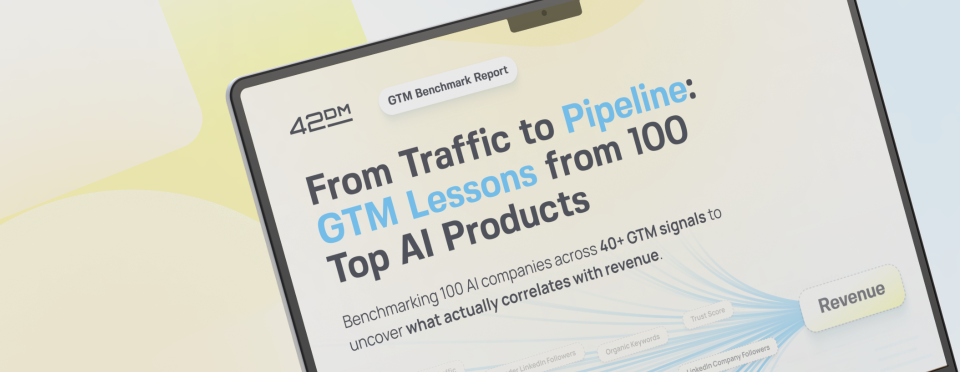
As AI makes generic synthesis cheap, proprietary data, customer proof, first-hand experience, named expertise, and strong points of view become more valuable.That is one reason we are putting more emphasis on original research at 42DM rather than publishing another version of what the market already knows. Explore the 42DM GTM Benchmark Research
Trust is becoming part of visibility
AI visibility is not only a retrieval problem. A brand also needs enough consistent evidence across the web to be represented accurately and credibly. That includes company and product facts, reviews, case studies, pricing guidance, expert content, external mentions, and the broader signals that help a buyer evaluate fit. Read the 42DM AI Visibility Report
Human judgment becomes more valuable as execution gets cheaper
One of the most important questions raised by the 2026 event was not how quickly teams can execute with AI, but how they decide what deserves to be executed at all.
AI can make production faster. It does not remove the need to decide which market matters, which buyer problem is real, what evidence supports the strategy, and when a workflow should remain human. That tension is likely to become more important as AI moves deeper into marketing and sales operations.
Where should B2B marketers start after UNBOUND?
Start with the buying process, not the tool stack. Identify where buyers are struggling to discover, understand, trust, or evaluate your company. Then look at the information and evidence available across your website and third-party sources. Fix inconsistencies, strengthen the pages that matter commercially, and make sure your distribution strategy reaches the places where buyers and AI systems actually look.
For a broader view of the event landscape, see our B2B Marketing Conferences 2026 guide.
Get an AEO Audit Before You Go
UNBOUND says AI now controls visibility for most B2B searches. So, before you spend the time and money getting to Boston, you should actually know: do your buyers find you when they ask ChatGPT, Perplexity, or Google’s AI overview? Most B2B teams have never checked.
Run an AEO audit and see exactly where your brand appears—or doesn’t—across the AI answers your buyers actually read. That’s where your visibility problem actually lives. It’s also what every conversation at UNBOUND will make you wish you already understood.
FAQ