How to Rank in AI Search: Lessons from the AI Visibility Industry Report
TL;DR
When buyers evaluate agent development tools, they don’t just scroll through Google search anymore. They ask ChatGPT, Perplexity, Gemini, and Claude for shortlists, comparisons, and recommendations.
42DM’s latest AI visibility benchmark shows an undeniable shift: market leadership in 2026 depends on more than great products, SEO performance, or broad brand awareness. To win, your platform must master cited pages, structured content architectures, crawlable foundations, third-party proof, and community signals.
Currently, top-performing platforms dominate because they have systematically transformed their websites into AI-retrievable answers and actively cultivated their community footprints across channels like Reddit, Quora and GitHub.
Introduction
Imagine a prospective customer typing this into ChatGPT or Perplexity:
“I need to build a multi-agent system for production. What tools are actually reliable?”
In a few seconds, the AI returns a shortlist of three or four recommended tools. If your platform is missing from that answer, you are invisible at the exact moment the buyer is looking for a solution. That is the new pressure point for agent development platforms.
For years, search visibility meant winning organic rankings, clicks, and traffic. While those metrics still matter, AI search introduces a new rule: your brand must be clear, cited, and trusted enough to appear inside the generated answer.
This article unpacks 42DM’s AI Visibility Report for agent development platforms. We translate complex benchmark data into actionable guidance on how to rank in AI search, using real-world performance data from LangChain, Gumloop, MindStudio, CrewAI, Dify, FlowiseAI, Relevance AI, LangFlow, Relay.app, and StackAI.
The Brutal Truth: Most “Great” AI Products Do Not Rank in AI Search
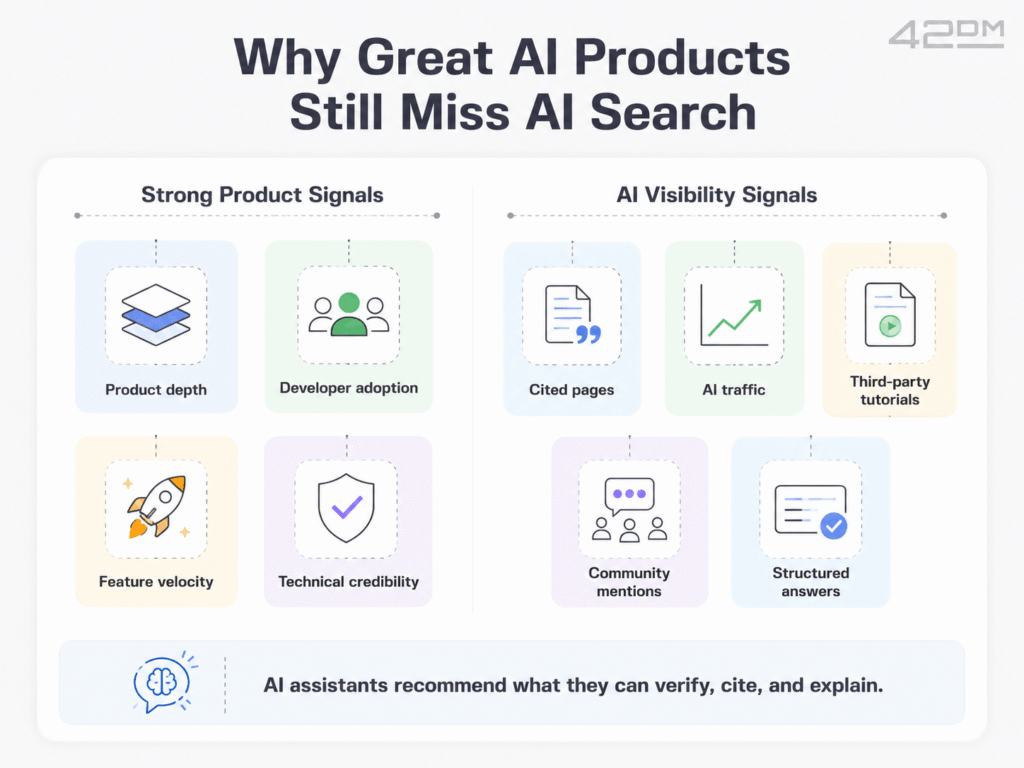
The agent development ecosystem is highly saturated. Dozens of platforms feature exceptional technical teams, rapid feature velocity, and deep developer utility. Yet, when users ask LLMs for recommendations, only a select cluster of brands appears consistently.
The visibility gap exposed in our AI visibility benchmark is entirely strategy-driven. Superior products are regularly ignored when AI systems cannot easily retrieve, quote, verify, and compare them.
A platform can have flawless documentation and still lose out to a competitor that builds clearer comparison pages, generates more third-party tutorials, fosters active community discussions, and formats data for AI retrieval.
If your platform sits outside the top three in AI recommendations, your traditional marketing metrics may be hiding a serious commercial risk. A solid domain rating or stable branded search volume doesn’t help you when a buyer asks an LLM, “What should I use?” and your product is left entirely out of the conversation.
Inside the 2026 AI Visibility Benchmark: Who Actually Shows Up?
How We Define AI Visibility
AI visibility measures a brand’s ability to appear, be cited, and capture traffic from AI answer engines. 42DM analyzed four core signal groups:
- AI citations and mentions: Mentions show how often a brand appears in LLM responses. Citations show when an AI system references your domain as a source.
- AI-referred traffic: Direct user visits originating from ChatGPT, Perplexity, Gemini, Claude, and other AI search engines.
- Website authority and content quality: Beyond domain rating, we evaluated content structure, schema deployment, author signals, team transparency, glossary structures, and public proof assets.
- Community and social signals: Activity across Reddit, Quora, GitHub, and LinkedIn. These channels matter immensely because AI engines actively train on and crawl the public spaces where practitioners compare tools in real language.
What the Leaderboard Reveals
The top tier of our benchmark features LangChain, Gumloop, and MindStudio.
- LangChain ranks first overall, capturing top scores across AI citations, referred traffic, and digital footprint.
- Gumloop claims second place, driven by highly robust AI citations, solid content signals, and a massive social presence.
- MindStudio takes third, showcasing exceptional citation strength relative to its baseline volume.
The pattern matters far more than the specific ranking.
LangChain leverages years of ecosystem momentum: infinite community tutorials, guides, and open-source GitHub discussions. Gumloop and MindStudio capitalize on intense recognition within AI automation circles, while CrewAI (4th place in the leaderboard) leverages open-source community strength. The takeaway? No single metric explains the winners. Backlinks alone don’t scale it, and raw brand noise isn’t enough. The leaders maintain a balanced profile across crawlable content, trusted third-party validation, and community activity.
Methodology: How We Measured Who Ranks in AI Search
42DM used its proprietary SAIO approach, developed over 18 months of intensive research analyzing how B2B tech companies surface inside LLM search layers.
The benchmark covered ten agent development platforms: LangChain, Gumloop, MindStudio, CrewAI, Dify, FlowiseAI, Relevance AI, LangFlow, Relay.app, and StackAI.
The data period was May 2025 through April 2026. Sources included Semrush AI tracking, Ahrefs website authority data, manual website audits, and community analysis across Reddit, Quora, GitHub, and LinkedIn.
It is crucial to note that this is purely a marketing and visibility assessment rather than a technical code review. A lower rank does not mean a weaker platform; it simply means the platform is currently less visible across the specific signals AI systems use to construct recommendations.
Stop Chasing Mentions: AI Citations Are the New Ranking Signal
Many marketing teams still treat AI mentions as the win. If ChatGPT drops their brand name into a paragraph, they assume their visibility strategy is working.
The benchmark tells a stricter story. Mentions matter, but citations matter more.
Mentions vs. Citations: Why AI Cares
A mention happens when an AI response includes your brand name. A citation happens when the AI response references your domain as a source.
Mentions can come from broad awareness. Citations usually require content that is specific, readable, trusted, and useful enough for AI to use as evidence.
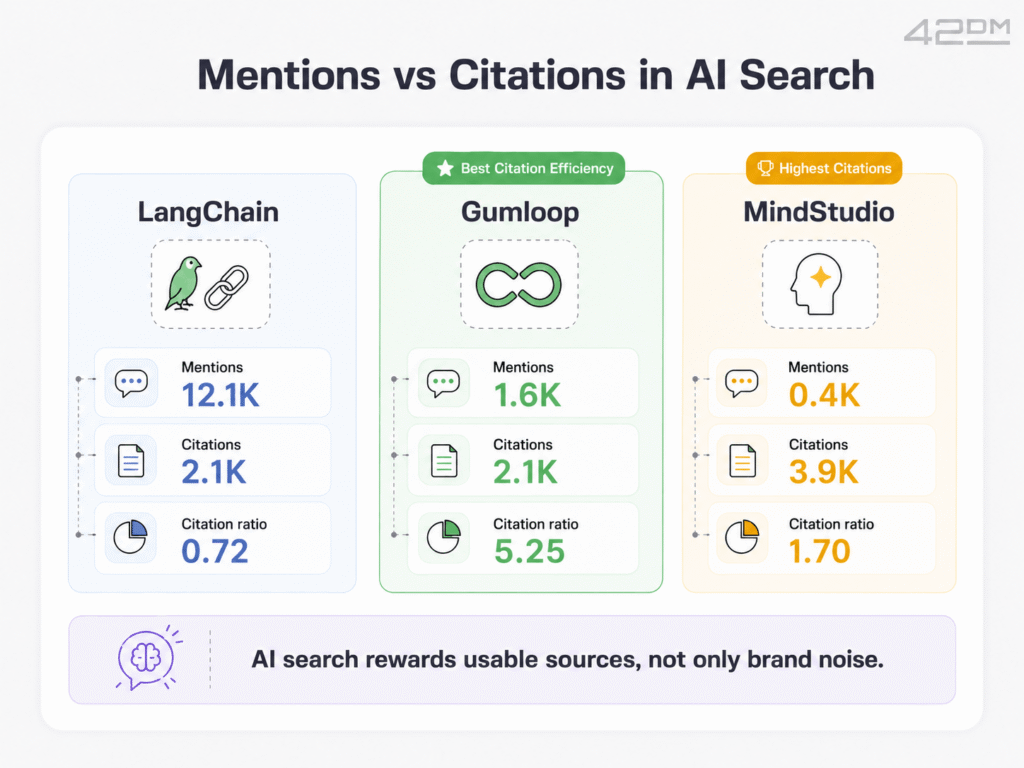
The report shows why citation quality can beat raw brand awareness. LangChain had 12.1K AI mentions and 2.1K AI citations. Gumloop had fewer mentions at 1.6K, but the same 2.1K citations and a much stronger citation-to-mention ratio (5.25). MindStudio had 3.9K citations, the highest in the citation table.
That matters for teams trying to rank in ChatGPT search. You do not need to be the loudest brand in the category. You need content and third-party proof that AI systems can use.
What Top Performers Do to Earn Citations
The report points to three patterns.
First, prioritizing developer community depth yields a massive dividend, as LangChain and Gumloop benefit from an army of developers actively writing third-party tutorials and comparison content, creating an external web of highly referenceable sources.
Second, these winners deliberately build modular, highly crawlable content hubs like glossaries, use-case FAQs, and technical documentation designed explicitly for rapid AI model retrieval.
Finally, they heavily leverage founder-led content and transparent technical updates on professional networks like LinkedIn, which builds strong semantic associations between the executive team, the brand, and specific topic authorities.
Why Traditional SEO Wins Do Not Guarantee You Rank in AI Search
Many growth teams assume that if they dominate Google, they will also dominate LLM search. The benchmark shows why that assumption breaks.
When Backlinks Don’t Translate into AI Visibility
Consider the cases of Dify and StackAI.
Dify boasted the single largest backlink profile in the entire benchmark with 279K backlinks. StackAI also held a sizable footprint with over 86K backlinks. On paper, traditional SEO frameworks would predict total dominance.
They didn’t get it. StackAI ranked at the bottom of the benchmark with minimal AI-referred traffic, while Dify’s visibility remained highly concentrated around a very narrow set of terms.
The lesson? LLMs do not reward raw backlink volume on its own, and relying solely on domain metrics will not help you secure a stable rank in AI search.
Why Referring Domains and Content Structure Matter More
AI engines prioritize deep domain context and cross-platform validation over raw link counts. They look for consistent patterns across multiple independent sources they can cross-reference and verify.
Furthermore, our technical audits exposed massive, category-wide gaps among most participants:
- Hidden or unindexed technical documentation.
- Entirely missing or broken schema markup.
- Thin proof assets and an absence of verifiable customer success metrics.
- Weak author entity signals (missing bios, unlinked team profiles).
If your site structure is messy, hard to parse, or disconnected from the actual prompts buyers type into an LLM, your high domain rating won’t save you from being filtered out.
How to Rank in ChatGPT Search: A Playbook from the AI Visibility Leaders
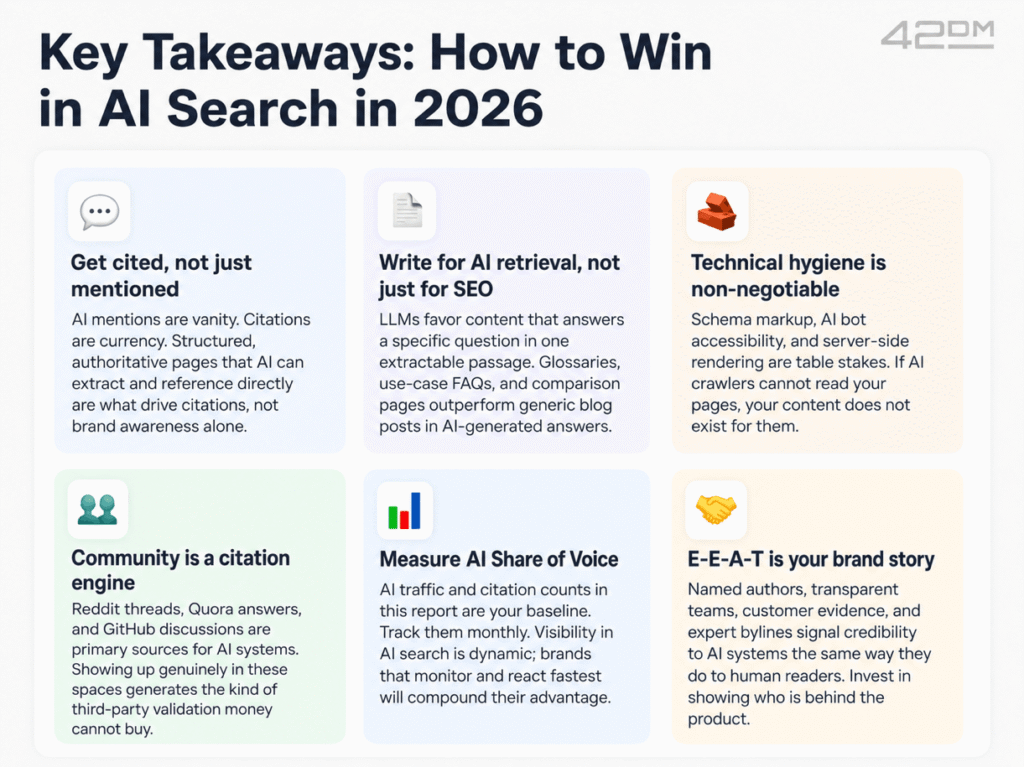
1. Design Pages for AI Retrieval, Not Just Google
Traditional SEO pages often target broad keywords, but AI search needs answer-ready content. For instance, a page targeting the high-volume head term “agent development platform” is far too broad for an LLM to utilize effectively. A superior AI retrieval asset answers a highly specific, multi-intent prompt directly:
“What is the best AI agent platform for a sales team that wants no-code workflow automation?”
That page should include a direct answer near the top, a comparison table, use case fit, technical limits, customer proof, schema, and internal links to related docs. The best formats from the report are glossaries, use case FAQs, comparison pages, docs, author attributed articles, and structured answer blocks.
2. Turn Your Community Into a Citation Engine
AI models actively crawl public forums to figure out what developers actually think about your product.
Our report observed a direct correlation between active community footprints across Reddit, GitHub, and LinkedIn and ultimate citation volume: LangChain and CrewAI benefit heavily from active GitHub ecosystems, while Gumloop wins through highly localized automation communities.
Interestingly, Quora remains completely underutilized. Seven out of the ten benchmarked platforms showed near-zero activity there, yet Quora answers frequently feed directly into LLM comparison engines. To capture these signals, you must systematically seed your community channels—across Reddit, GitHub, LinkedIn, and Quora—with real use cases, answers, and clear documentation.
3. Fix Technical Foundations So AI Can “See” You
Site architecture often takes a back seat during rapid product deployment. Surprisingly, even top visibility leaders like LangChain and Gumloop showed only moderate technical baseline scores, leaving massive room for improvement in structured data and mobile performance.
Because many platforms face similar indexing issues, technical cleanup can become a fast advantage. Start with the basics: add schema markup that clearly defines product categories, features, use cases, authors, FAQs, and comparison pages. Check server logs to make sure AI crawlers such as GPTBot and CCBot are not being blocked. Serve core documentation and landing pages in a way that lightweight crawlers can access without waiting on client-side rendering.
4. Measure AI Share of Voice and Iterate
Most teams still report SEO traffic, rankings, leads, and pipeline. AI visibility needs its own layer.
Track AI citations and AI referred traffic, cited pages, AI mentions, share of voice across key prompts, sentiment in AI answers, top third-party sources, and which competitor pages get cited.
This turns AI visibility from a vague concern into a management system.
What to Do If You’re Not in the AI Visibility Top 3 (Yet)
Diagnose Your Current AI Visibility Profile
Start with a baseline.
Identify which prompts mention your brand, which ones cite your site, and which competitor pages are capturing those citations. Uncover the third-party platforms shaping your broader category, track your incoming traffic from ChatGPT and other AI engines, and ensure your core assets—like documentation, glossaries, FAQs, and comparison pages—are fully crawlable.
Then map your platform against the benchmarked leaders. This comparison will pinpoint whether your largest strategic gap lies in raw citations, content structure, technical indexation, domain authority, or your overall community presence.
Prioritize Interventions with Fastest Impact
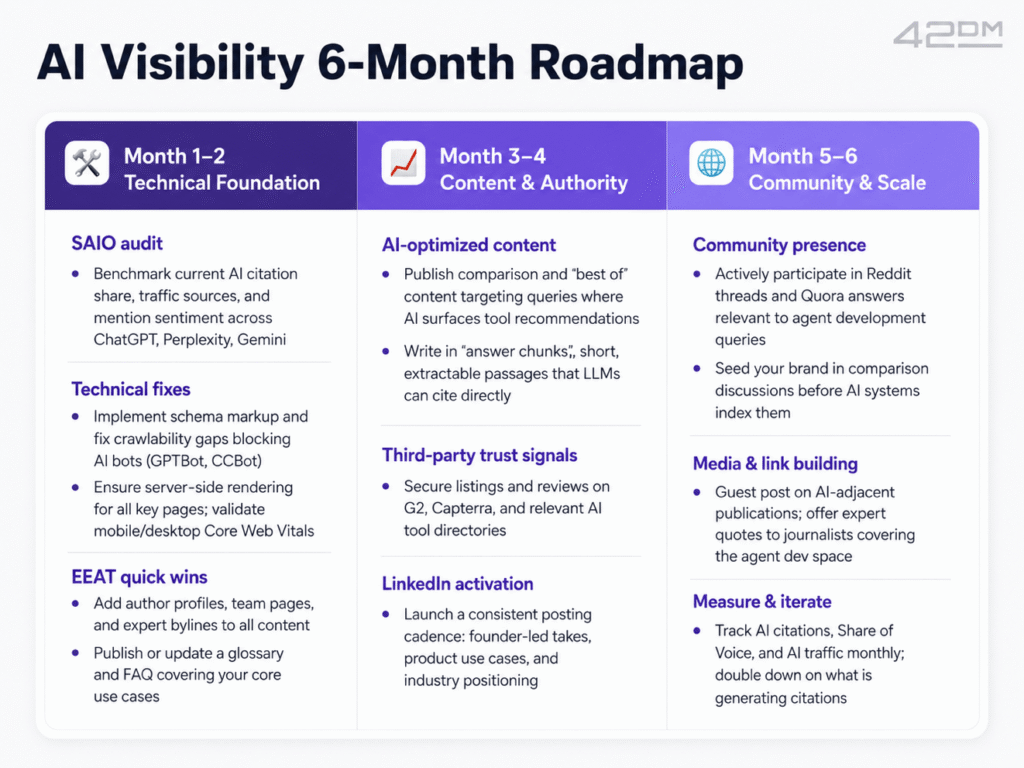
Systematic optimization across technical hygiene, structured content formatting, and targeted community seeding can completely transform a platform’s footprint in just a few short months.
The report highlights a case study of a mid-stage platform that climbed from position six to a consistent top-three recommended spot in ChatGPT within a six-month window.
This overhaul required deploying clear schema markup, building verified author profiles across more than 40 articles, publishing 20 use-case FAQs, and restructuring existing content into extractable answer chunks. Additionally, the team launched eight dedicated competitor comparison pages, optimized their presence on G2 and Capterra, and initiated consistent engagement across Reddit, Quora, and LinkedIn.
These compounding efforts delivered massive operational gains, resulting in a 220 percent lift in AI citations alongside a 185 percent surge in monthly AI-referred traffic.
This case study proves that a focused three-to-six-month roadmap drives measurable visibility when optimization compounds across content, community, technical access, and dedicated measurement. To shift your own rankings, start by engineering pages that AI engines can seamlessly quote, establish a footprint where buyers actively compare tools, eliminate technical crawlability blockers, and use real prompt data to double down on what gets cited.
When to Bring in a SAIO Partner
If your team is running at full speed building product, managing these shifting optimization layers can be daunting. That’s where an expert SAIO partner steps in. 42DM specializes in auditing, engineering, and scaling AI search visibility for high-growth B2B tech and developer platforms.
If your team wants to understand where you rank today, why competitors are being recommended above you, and what to fix first, explore 42DM’s AI Search Optimization Services to request a custom AI visibility audit.
FAQ: Quick Answers on How to Rank in AI Search